
Skin cancer
Skin cancer is the most common form of cancer, and it is becoming more common. It is best treated early.
Skin cancer is the uncontrolled growth of abnormal skin cells. There are two general types, melanoma and non-melanoma. Both are mainly caused by too much sun, and are more common in people with light skin, blue eyes and red or blond hair.
Check your skin regularly
Skin cancers are best treated when they are still small and thin, and unlikely to have spread. Use a full-length mirror, or ask a partner to help with the places you cannot see, and look for:
- Spots and sores that itch, crust or bleed
- Open sores that do not heal within 4 weeks
- Moles or beauty marks that change colour or texture, have an irregular shape, are growing, or are new
See a doctor about any suspicious spot.
Basal cell cancer
Basal cell cancer (BCC) is the most common form of skin cancer and the least dangerous. It rarely spreads to other parts of the body and is generally not a threat to your life. Left alone, though, it keeps growing and damages the surrounding skin, so it must still be treated properly.
What it looks like
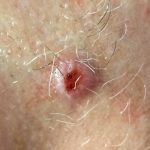
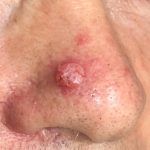
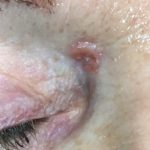
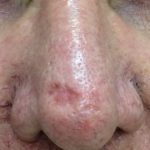
BCCs usually appear on sun-exposed areas such as the face and neck, trunk, arms and legs. Their appearance varies. The early warning signs are:
- A firm, flesh-coloured or slightly reddish bump, often with a pearly border. Small blood vessels on the surface may give it a red colour.
- A sore or pimple-like growth that bleeds, crusts over and then reappears. Any sore that does not heal within 4 weeks should be examined by a doctor.
- A small, red scaling patch.
What causes it
Ultraviolet (UV) radiation from the sun is the main cause, especially frequent severe sunburns in childhood. Fair-skinned people who burn easily are at highest risk. BCCs usually appear after age 50, but are sometimes seen in teenagers and young adults. Organ transplant patients, whose immune systems are suppressed, are also at higher risk.
How it is treated
Treatment depends on the tumour (its size, location and so on) and on your own health. Options may include surgical excision, shave and desiccation (shaving, then sealing with heat), cryotherapy and/or radiation. Your doctor will help decide which treatment or treatments are best for your cancer.
Squamous cell cancer
Squamous cell cancer (SCC) is the second most common form. Like BCC, it can be very destructive to the surrounding tissue. It is more worrisome because, if it is not treated, it can sometimes spread to lymph nodes or other organs, which can be life-threatening. It must be treated.
What it looks like
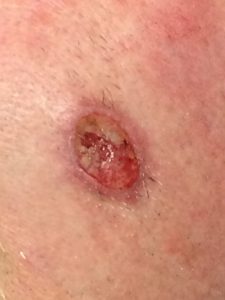
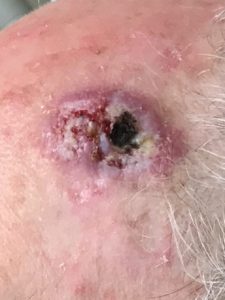
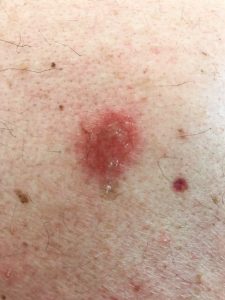
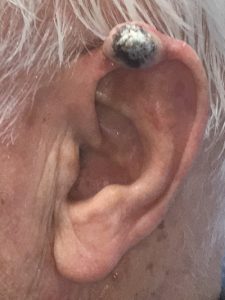
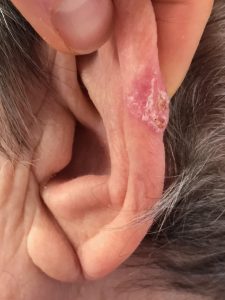
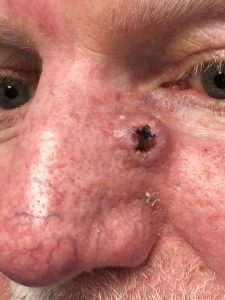
SCC appears on chronically sun-exposed areas such as the head and neck, arm, back of the hand and leg. It can be particularly aggressive on the ear or the lip.
SCCs appear as thickened, red, scaly bumps or wart-like growths. They may also look like an open sore or crusted skin. This type of skin cancer may grow quickly, over a few weeks.
What causes it
Frequent and cumulative sun exposure is the leading cause. People who have suppressed immune systems, or who take anti-rejection drugs, are also at higher risk.
How it is treated
Treatment is mainly surgical excision or radiation.
Melanoma
Melanoma is less common than basal and squamous cell cancer, and the most dangerous of the three, because it is the most likely to spread to other organs.
Found early, before it has spread, melanoma is cured in the great majority of cases. A more advanced melanoma grows deeper into the skin, where it can reach the bloodstream or lymph system and spread, which can be life-threatening.
What it looks like
Melanoma can develop in weeks or months, or take years. It can appear as a new mole or freckle-like spot on the skin, or in an existing mole that has started to change.
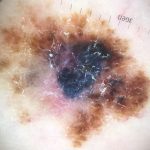
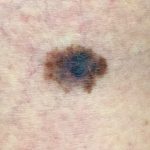
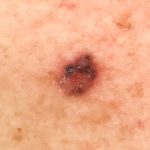
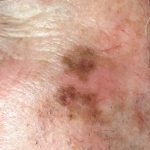
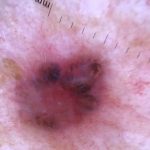
Know the ABCDE features that are suspicious for melanoma:
- Asymmetry. Is the shape different from one side to the other?
- Border. Are the edges irregular?
- Colour. Are there multiple colours in the spot?
- Diameter. Is the spot larger than about 6 mm, the size of a pencil eraser? Melanomas can be smaller.
- Evolution. Is the spot changing in any way: new, growing, changing shape or colour, becoming itchy or bleeding?
The ugly duckling sign. Most of a person’s moles look alike. A mole that looks, feels or changes differently from the others may be a melanoma, and should be checked by a doctor as soon as possible.
Not all melanomas look this way; a few have no brown colour at all. Have a doctor check any new or changing spot that does not go away after a few weeks.
What causes it
Too much exposure to ultraviolet (UV) from the sun and tanning beds plays a leading role in melanoma, and is its most preventable cause. Most melanomas are associated with UV exposure and sunburns over a lifetime.
Other features that put people at higher risk:
- Light skin, fair hair and eyes, and lots of freckles
- Lots of moles on your body
- Having had a melanoma already
- A close family member who has had melanoma
The more risk factors you have, the higher your risk. Even so, people with no risk factors, and people with darker skin, can sometimes develop melanoma.
How to protect yourself
Check your skin every month, protect it from the sun all year round, and avoid tanning beds. See a doctor about any suspicious spot.
Early detection and treatment are directly linked to a high survival rate.
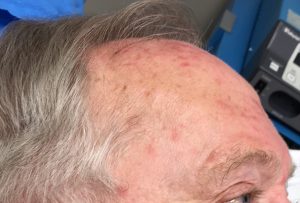
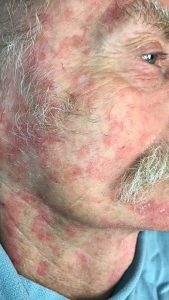
Actinic keratoses
Actinic keratoses (AKs) are not true skin cancers, but it is important to have them treated because they can change into squamous cell skin cancers. They are usually treated by freezing, or with creams prescribed by a dermatologist.
What they look like
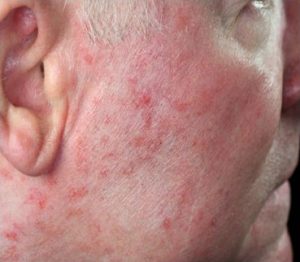
AKs appear on sun-exposed areas such as the face, ears, scalp, neck and chest, back of the hand, forearm and leg. People can have one, a few, or many at a time. They can appear as:
- Red, rough, scaling spots, which may sting or itch
- Hard, horn-like bumps, especially on the ears
- Dry, cracked or scaling skin along the edge of the lower lip that does not heal
How skin cancer is treated
Most skin cancers are removed with surgery, usually as a same-day procedure under local anesthetic. Some are treated by freezing, shaving, prescription creams or radiation. Your doctor will recommend what suits you and help you through the decision.
Surgery
The skin is numbed with local anesthetic and the cancer is cut out, in one of these ways.
Local excision. The surgeon cuts out all the visible skin cancer along with a small cuff of normal-looking skin, to catch any “fingers” of cancer cells that extend from the main tumour. The wound is repaired, and the removed skin is sent to the lab, which reports in a few weeks whether all of the cancer was removed. This cures the great majority of skin cancers; the rate is somewhat lower for cancers that have come back after earlier treatment.
Local excision with frozen section margins. The same operation, except that a rim of extra tissue is analyzed by the lab during the surgery, usually over 1 to 2 hours, to check whether any cancer remains. It is most useful for recurrent cancers and ones that are hard to see with the naked eye. It is done in a hospital and takes a lot of resources, so it is used only in special circumstances.
Mohs surgery. Specially trained surgeons, usually dermatologists, remove the cancer in thin layers and examine each one under the microscope while you wait, until no cancer remains. It offers the highest cure rates. It is not currently available in our region, so it means additional wait time and travel to Kingston or Toronto.
Cryotherapy
Liquid nitrogen spray freezes the unwanted tissue. It is used for some skin cancers and for benign spots such as warts. After cryotherapy explains what to expect.
Shave excision and biopsy
Shave excision is usually used to biopsy areas of skin that are suspicious for skin cancer. It is also sometimes used to treat selected early and pre-cancerous spots.
A blade shaves off the suspicious skin with a very shallow cut. The base of the wound is then usually cauterized (sealed with heat), to prevent bleeding and kill off any remaining pre-cancerous cells.
The sample is sent to the lab for analysis. If the lab finds pre-cancerous tissue, usually no further treatment is required. If skin cancer is found, further treatment is usually needed to make sure it is fully removed.
After a skin biopsy explains how to care for the site.
Prescription creams
Creams are sometimes prescribed, usually by a dermatologist, to treat widespread sun damage and some early skin cancers.
Radiation
Radiation is occasionally recommended for skin cancer. It can be useful when:
- Surgery is not possible (because the cancer is very widespread, your health is poor, or the tumour is hard to reach)
- You prefer not to have surgery
- Cancer remains even after surgery
- The cancer has very aggressive features (invasion into nerves, bone, lymph tissue, blood vessels and so on)
Radiation works well for some skin cancers, but it has drawbacks:
- Once only. Radiation can usually be given to an area only once in your lifetime. If you are at risk of getting another cancer in a similar area, radiation may not be a good choice now.
- Later cancers. Radiation carries a small risk of causing a new cancer in the area many years later, which matters more if you are young.
- Daily visits. Treatment means daily trips to the hospital for several weeks, which many patients find hard to manage.
- Side effects. Radiation damages both diseased and healthy tissue in the area. Depending on the part of the body treated, this can cause unwanted side effects (skin inflammation, dry mouth, hearing loss, visual damage and so on).
Preventing skin cancer
The best way to treat a skin cancer is to prevent it. Protect your skin from the sun all year, avoid tanning beds, and teach children good sun habits early: bad sunburns in youth are one of the biggest risk factors for skin cancer later in life. Sun protection explains how.